Urban Sketching on Holiday: Drawing the Place You Are In
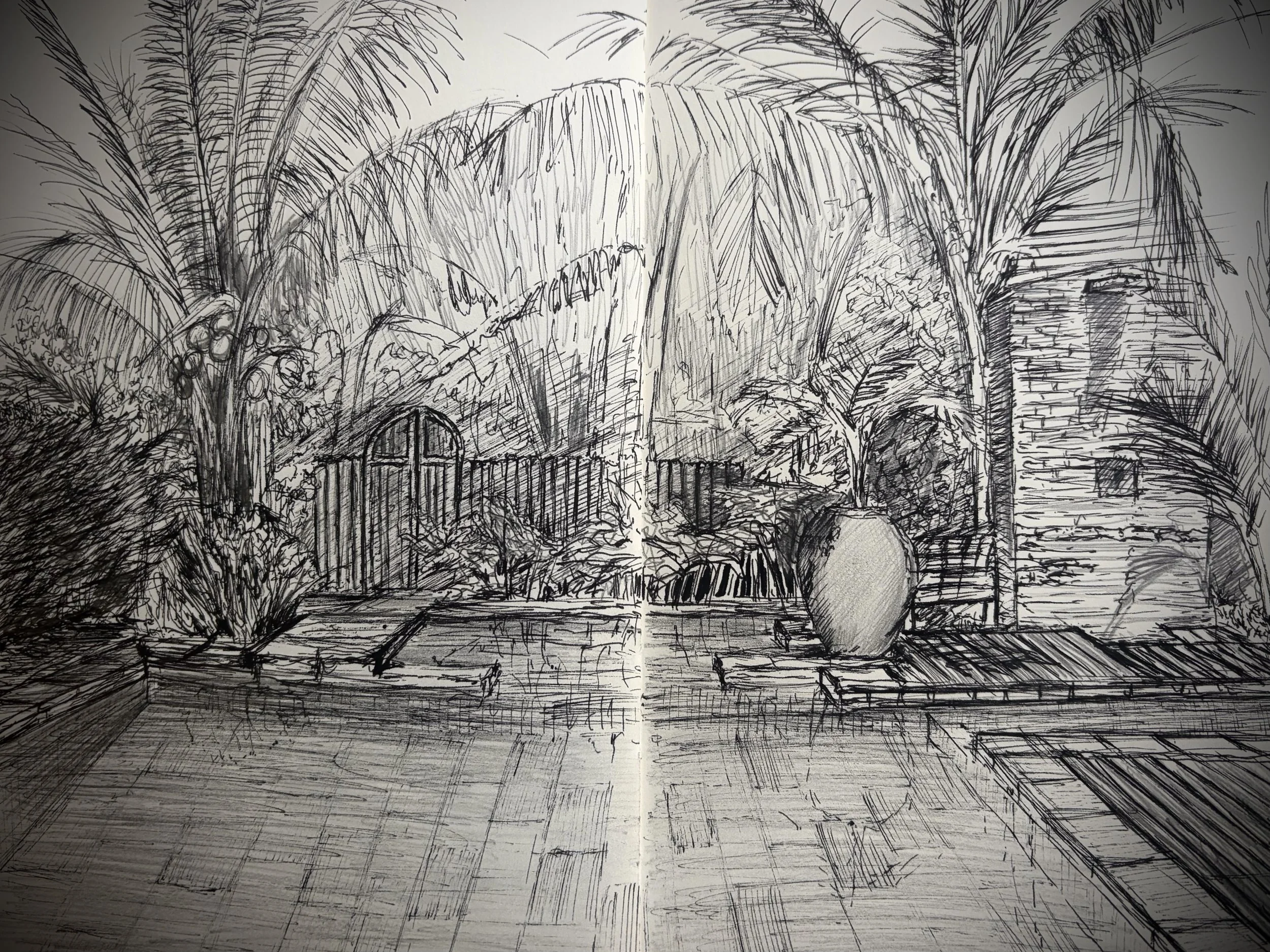
I drew this ink sketch while I was away on holiday. It records a view of palms, planting, a gate, a path and the shaded structure around me, spread across two sketchbook pages.
It is not a measured architectural drawing and it was never meant to be. What matters to me is that it holds the experience of stopping, looking and deciding what deserved a mark.
Holiday sketching should fit the holiday
The easiest way to stop drawing while travelling is to make it another obligation. You do not need to fill a book, complete a polished piece every day or ignore the people you are travelling with.
Choose one manageable opportunity: half an hour before breakfast, a quiet period by the pool or a seat while everyone else is reading. A short drawing made willingly will tell you more than a complicated one completed out of duty.
Carry less than you think you need
For an ink sketch, a small or medium sketchbook and one dependable pen are enough. Add a pencil only if you like to establish a few proportions first. A second pen with a different line width can be useful, but a large case of materials often creates more decisions than freedom.
Check that the ink suits the paper and will not bleed heavily through the page. If you may add watercolour later, choose waterproof ink and paper that can tolerate a light wash. Test that combination before travelling rather than discovering the problem in front of the view.
Choose a view that means something to you
The most famous sight is not automatically the best drawing. I chose the view in front of me because it contained the feeling of the place: large palm shapes, patterned shade, a gate leading through the garden and the contrast between open light and dark shelter.
Look for one relationship that interests you. It might be a narrow street opening into bright sky, café chairs under an awning or foliage framing a doorway. That relationship becomes the reason for the page.
Turn slowly and use your fingers as a simple frame. Decide where the drawing will begin and end before adding marks.
Plan the page before committing to detail
My sketch runs across the centre fold. That creates scale, but it also introduces a physical interruption. Before working across a spread, check which important shapes will cross the gutter. A face or small focal detail may be better placed away from it, while a path, wall or area of foliage can cross more comfortably.
Mark the highest, lowest, leftmost and rightmost points lightly. Place the large verticals and the main direction of the ground. These few decisions stop the scene drifting off the page.
Do not establish every leaf, brick or chair. First decide how much space belongs to sky, foliage, buildings and foreground.
Build the scene from anchors
In a busy view, choose two or three anchors. In this drawing, the gate, the pot and the strong post on the right help hold the scene together. Once those are placed, the surrounding plants and surfaces can relate to them.
An anchor does not have to be the largest object. It is simply a shape whose position and proportion help you judge the rest. Draw its main silhouette, then compare distances: how far is the gate from the edge; where does the pot sit against the post; where does the path narrow?
This is more reliable than finishing one corner and hoping the rest fits.
Use line direction to describe different surfaces
Ink cannot depend on colour alone, so line direction becomes important. Vertical strokes can suggest falling palm fronds or deep shade. Short horizontal marks can describe brick, timber or a flat ledge. Broken, varied marks suit irregular planting better than repeated identical symbols.
Let the pen follow the form. A rounded pot needs marks that help it turn. A palm trunk benefits from bands or changes in direction. The ground can use perspective lines that lead the eye into the scene.
Vary the density as well as direction. More marks create darker value; open paper becomes light.
Decide where the darkest darks belong
Travel scenes contain information. Strong dark areas give that information structure. In my sketch, the shaded foreground, gate, roof areas and right-hand post create a pattern that helps the lighter foliage remain readable.
Squint at the view and identify the largest dark shapes. Connect some of them where appropriate, but do not fill every shaded area equally. A few deep accents near the focal area can be more effective than covering the whole page in cross-hatching.
Leave clean paper deliberately. White space is part of an ink drawing, not an area you failed to finish.
Accept movement and changing light
On location, people move, chairs are rearranged and shadows change. You are drawing an experience, not collecting forensic evidence. If something important moves, decide whether to keep its first position, adapt it or leave it out.
Changing light can be handled by choosing one moment. Establish the main shadow pattern early, then remain consistent even if the sun shifts. Trying to chase every change can make the values confused.
A quick photograph can preserve the original light if you want to add a few marks later, but keep the on-location decisions as the heart of the drawing.
Let mistakes become part of the page
Ink is often avoided because it cannot be erased. That is also its strength. A line that lands slightly differently can be repeated, absorbed into tone or allowed to remain as evidence of looking.
Avoid thickening every uncertain line until it becomes a heavy border. Sometimes the lightest correction is to place the next relationship more accurately and let the eye accept the earlier mark.
Travel sketchbooks become more interesting when they contain honest attempts, notes, dates and unfinished sections—not only pages that look ready to frame.
Try one travel-sketching session
Give yourself thirty minutes. Spend five choosing and framing the view, five placing the main shapes, fifteen building line and value, and five adding the darkest accents and a note. If you have longer, continue only because you are still interested.
The result does not need to resemble anyone else’s idea of urban sketching. It needs to help you notice and remember where you were.
Ready to take the next step?
If you would like relaxed guidance with watercolour, drawing or coloured pencil, I offer private art lessons for adults in Teddington and South West London, as well as online. We can work at your pace and build a process that makes painting feel enjoyable rather than intimidating.