Why Drawings Don’t Need to Be Perfect to Feel Powerful
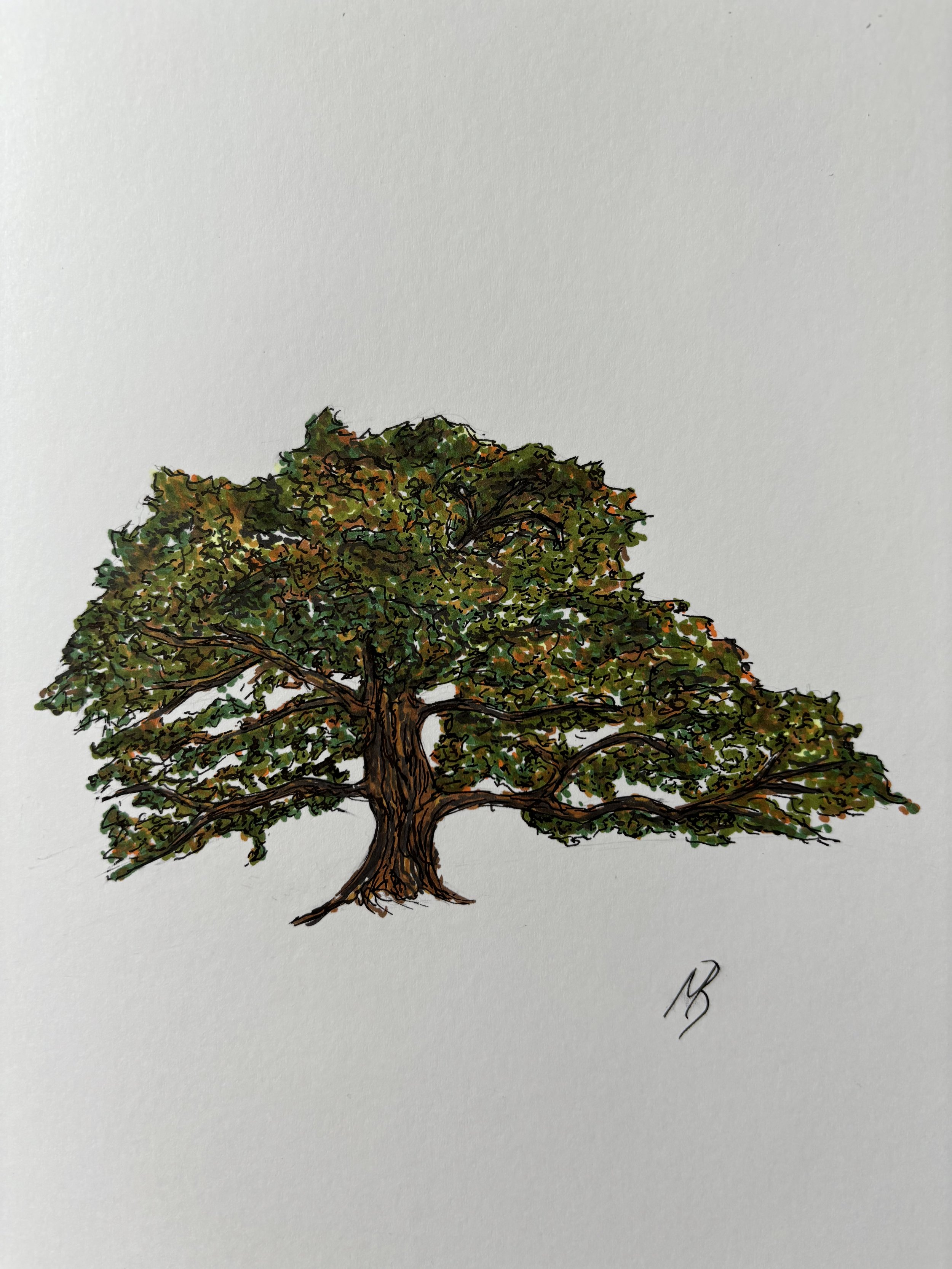
Expressive tree drawing created with markers using loose interpretive line work pen ink and markers
One of the biggest things that stops people enjoying drawing is the belief that everything needs to be perfectly accurate.
Perfect proportions.
Perfect perspective.
Perfect realism.
But some of the most interesting drawings are not exact copies at all.
They’re interpretations.
Drawing is not photography
When you draw something like a tree, you’re making decisions the entire time.
You decide:
what to simplify
what to exaggerate
what to leave out
where to place detail
how loose or controlled the marks should feel
That’s what makes drawing personal.
Two artists can sit in front of the exact same subject and produce completely different work.
Neither is necessarily “more correct”.
Different materials create different feelings
The materials you use naturally influence the character of the drawing.
Markers, for example, encourage:
bold shapes
expressive marks
layering
texture
simplification
They often push you towards a more interpretive style because they don’t allow endless tiny corrections.
And that can actually be very freeing.
Instead of chasing perfection, you start responding more instinctively to shape, rhythm and contrast.
Trees are a great subject for expressive drawing
Trees work particularly well for this kind of approach because they already contain:
irregular shapes
organic movement
layered texture
unpredictability
Branches don’t grow perfectly.
Edges aren’t symmetrical.
Textures constantly change.
That makes trees ideal for experimenting with looser, more personal mark-making.
Your style develops through repetition, not forcing it
A lot of people worry about “finding their style”.
Usually, style is not something you consciously invent.
It develops naturally through:
repetition
preference
confidence
observation
the materials you enjoy using
Over time, certain marks, textures and approaches simply begin appearing more consistently in your work.
That becomes part of your visual language.
Exact realism is only one approach
Highly realistic artwork can be incredibly impressive.
But realism is not the only measure of a successful drawing.
Sometimes a loose drawing with energy and personality feels far more engaging than something technically perfect but emotionally flat.
Interpretation matters.
Character matters.
Atmosphere matters.
Looser work often teaches observation better
Interestingly, drawing more freely often improves observation.
When you stop obsessing over exact detail, you begin noticing:
larger shapes
movement
balance
contrast
rhythm within the subject
You start drawing what you actually see rather than what you think something should look like.
The goal is not perfection
One of the most valuable things drawing can become is a process of observation and expression rather than judgement.
That shift changes everything.
You stop asking:
“Is this perfect?”
And start asking:
“Does this feel interesting, alive or expressive?”
That’s often where the enjoyment returns.
Developing confidence in your own marks
Confidence in drawing does not come from never making mistakes.
It comes from becoming comfortable making marks without constantly second-guessing yourself.
That takes time.
But allowing yourself to experiment with different materials and looser approaches is often one of the best ways to grow creatively.
One-to-one art lessons online and in person
If you’d like to develop your drawing style, loosen up your work, or explore different materials and approaches, I offer one-to-one art lessons tailored to your pace and interests.
Lessons are available online and in person, covering everything from observational drawing and realism through to more expressive and interpretive techniques.
Sometimes the most interesting work begins when you stop trying to make everything perfect.