Urban Sketching in Pen and Ink: Drawing Buildings on Location
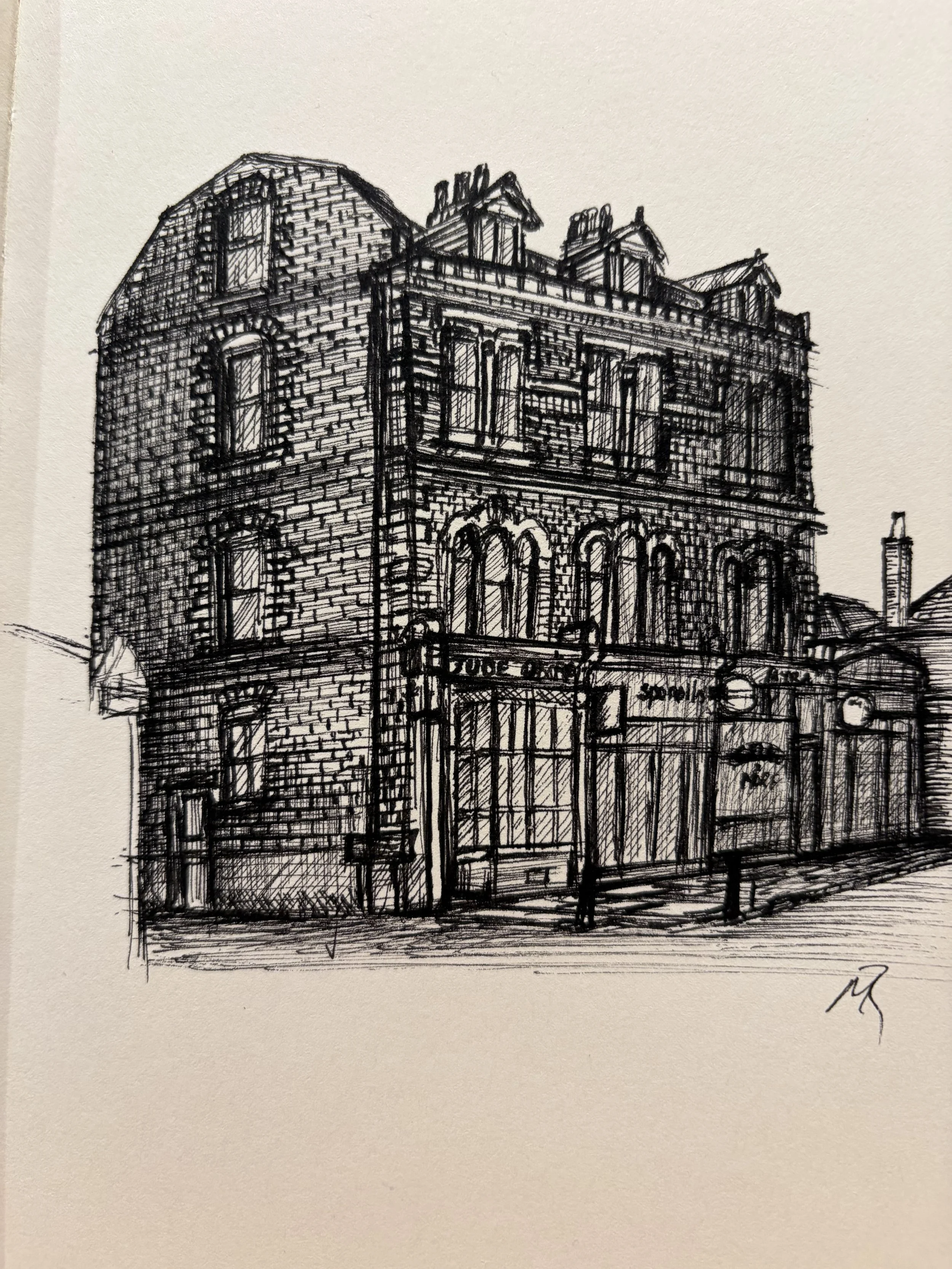
Urban drawing - Buildings in Teddington - Drawn by Mark Mannering Barton
There’s something different about drawing when you’re outside.
You’re not working from a perfect photo.
You’re not adjusting composition on a screen.
You’re standing there, looking, deciding what matters and committing to it in ink.
That shift changes everything.
Why drawing on location feels different
When you’re sketching a building like this, you don’t have the luxury of endless correction.
Pen and ink forces a slightly different mindset:
you simplify
you prioritise
you accept imperfections
And that’s exactly where the character comes from.
You start noticing things you’d usually ignore. The rhythm of the windows, the way brickwork breaks light, the slight lean in a line that gives the whole drawing life.
You don’t need to capture everything
Looking at a building like this, it’s easy to feel overwhelmed.
There’s detail everywhere:
brick patterns
window frames
signage
architectural features
But the drawing isn’t about copying every single element.
It’s about choosing what to include.
In this piece, the focus is on structure first, the main shapes, the angles, the proportions, and then layering detail where it adds something.
A suggestion of brickwork is often more effective than trying to draw every brick.
Start with the big shapes
When you’re out sketching, it helps to think in simple blocks first.
Before any detail goes in:
where does the building sit?
what are the main verticals and horizontals?
how does the perspective shift across the structure?
Getting that right early on makes everything else easier.
Even if the lines aren’t perfect, the drawing will still feel solid.
Let the lines stay loose
One of the strengths of pen and ink is that it doesn’t need to be overly controlled.
In fact, it’s often better when it isn’t.
In this drawing:
lines aren’t perfectly straight
edges are built up with multiple strokes
shading is created through repeated marks rather than smooth blending
That looseness gives the piece energy.
Trying to make everything precise can actually take that away.
Building depth through line
Without colour, everything comes down to how you use the pen.
Depth is created through:
line weight (heavier lines for shadow and structure)
density (more marks = darker areas)
direction (cross-hatching to suggest form)
You don’t need to shade everything.
Just enough contrast to guide the eye and suggest where light is falling.
Working with what’s in front of you
Drawing on location means things aren’t perfect.
People walk past.
The light changes.
You don’t always have the best angle.
But that’s part of the process.
Instead of waiting for the “ideal” setup, you work with what’s there.
And often, that leads to more interesting results.
Keeping it simple
You don’t need much to do this kind of drawing.
A small sketchbook and a pen are enough.
That simplicity is part of the appeal you can stop anywhere and start drawing.
No setup, no pressure.
Just observation and mark-making.
Why it’s worth doing
Urban sketching isn’t just about the finished drawing.
It’s about:
slowing down
noticing detail
improving how you see structure and form
Over time, that carries into all your drawing even when you’re working from photos or in the studio.
Learn to draw with confidence with me
If you’re interested in developing your drawing, whether that’s pen and ink, pencil work, or more structured lessons, I offer one-to-one art sessions tailored to your pace and interests, both in-person and online.
Just fill the form in at the bottom of the page linked here